Every year, more facilities managers and skilled-trades workers are leaving the industry, just as demand for their labor is rising.
JLL estimates that 2.1 million skilled-trade jobs could go unfilled by 2030, with annual economic losses reaching $1 trillion.
Facilities management is facing its own workforce squeeze. IFMA estimates that over 45% of facilities management professionals worldwide could retire within the next decade. The Bureau of Labor Statistics projects roughly 36,100 openings for administrative services and facilities managers each year through 2035. Many of those openings are expected to stem from a need to replace workers who have exited the labor force or retired.
Employers are already investing in compensation, amenities, and benefits to retain experienced workers. But one workplace condition affecting their physical capacity is rarely part of that conversation: the floor itself.
In modern facilities, hard, flat surfaces like concrete and tile are durable, easy to maintain, and allow people, equipment, carts, and machinery to move efficiently through buildings. But those benefits come with a tradeoff. Workers spend eight-hour shifts moving on surfaces that do not account for the natural movement of the human foot.
With the labor gap expected to widen, it is important for facilities managers to address that tradeoff, so they can retain the capacity of the workers they already have.
The Workplace Risk Lurking Underfoot
Facilities leaders routinely evaluate lighting, acoustics, workstation ergonomics and the need for automated natural ventilation. But the floor is not always regarded with the same level of scrutiny.
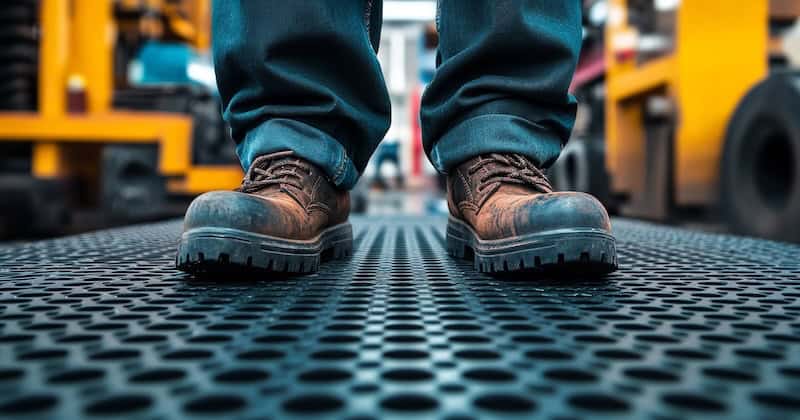
Across factories, construction and renovation sites, warehouses, hospitals, and restaurants, skilled-trades workers, maintenance teams, and other frontline employees spend hours standing and walking on concrete and tile.
Over two million years, human feet have evolved to move across uneven terrain rather than uniformly flat, rigid surfaces.
Understanding what that means begins with the subtalar joint, located between the lower ankle and the heel. The subtalar joint helps the foot tilt, adjust, and stay balanced as a person moves. It transmits forces from the feet up through the legs. When that motion is repeatedly challenged during the course of a work-shift, the knees, hips, and lower back may compensate, contributing to fatigue and greater musculoskeletal strain over time.
That’s not a recent scientific discovery. As early as 1941, Dr. John T. Manter described how the subtalar joint operates around an axis that is 42 degrees from the horizontal plane and 16 degrees from the vertical plane.
A uniformly flat surface can create a geometric mismatch with a joint that naturally moves around an oblique, three-dimensional axis. That’s why the surface beneath the foot deserves consideration as part of workplace ergonomics.
Why Traditional Footwear Solutions Fall Short
Cushioned shoes and inserts can soften the surface beneath the feet, while custom orthotics can be molded to address the needs of an individual wearer. But cushioning is designed primarily to absorb force, while custom interventions can be expensive and difficult to deploy for thousands of employees. Neither approach changes the underlying geometry the foot encounters when it meets the ground.
A long-standing model describes the foot as a “mobile adaptor” that is relatively flexible when it contacts the ground before it becomes more rigid during push-off to help propel the body forward. A 2023 Biological Reviews paper examined that model and noted that its key elements had never been experimentally validated. Current evidence suggests the foot instead operates through far more adaptable, three-dimensional mechanics, with the subtalar joint helping the foot respond to forces coming from the ground and the rest of the body.

More recently, footwear brands with heavily cushioned midsoles and rocker geometry have gained popularity in the mainstream market. But not all of these products provide protective-toe options and other job-specific safety features that HVAC technicians, maintenance personnel, building engineers, and other facilities workers require.
Proper footwear is important in a logistics environment, where workers spend long shifts standing and walking on hard, flat surfaces.
The challenge for employers is how they can preserve the operational benefits of hard, flat floors while reducing the physical strain those surfaces place on workers.
Protalus approaches that problem by changing the geometry beneath the foot rather than trying to “correct” the foot. Its Landing Gear workplace insert is designed to provide a three-dimensional surface inside the shoe that more closely corresponds to how the foot naturally moves.